When Growth Changes the Way a Company Needs to Operate
Why Legacy-Driven Service Businesses Can Quietly Lose Resilience — Even When Growth Looks Healthy
There’s a point in many service-based businesses where the challenge quietly changes.
Not because the company is failing. Not because the team suddenly became incapable. Not because the owner lost focus, ambition, or work ethic.
In fact, on the surface, the business may still look healthy.
Revenue is solid. Clients are coming in. The team has grown. The company has traction.
Yet internally, something feels different.
The business feels heavier to lead.
Not necessarily chaotic. Not necessarily broken.
Just… harder.
Operationally heavier. Mentally heavier. More difficult to keep aligned. More demanding to sustain consistently.
And many seasoned business owners struggle to fully pinpoint why.
Because the issue often isn’t obvious.
It doesn’t always show up first in declining revenue. Or a major operational failure. Or one dramatic event.
More often, it shows up gradually.
The company becomes increasingly dependent on constant alignment between people, priorities, communication, client delivery, leadership decisions, and operational execution.
And that changes the nature of owning and running the company.
What originally helped build momentum in the business may no longer be enough to stabilize the next stage of growth.
That’s not failure.
It’s organizational evolution.
And for many established service firms, this is the stage where ownership either begins improving more intentionally… or starts quietly becoming more operationally expensive.
Early Growth Rewarded Responsiveness
Most service-based businesses initially grew through responsiveness.
Especially in industries like:
- marketing agencies
- IT consulting firms
- creative service businesses
- implementation-based firms
- advisory and professional services
In the earlier years, growth often depended on:
- speed
- accessibility
- founder involvement
- adaptability
- client responsiveness
- quick problem-solving
- people stepping in wherever needed
And in many ways, that works.
The owner stayed close to:
- clients
- delivery
- communication
- team direction
- decision-making
- problem resolution
The organization operates with a high degree of flexibility.
People fill gaps quickly. Communication is informal. Priorities shift rapidly. Operational flow adjusts in real time.
At smaller scale, this can actually create momentum.
The business moves fast. The team feels connected. Clients feel supported. The owner has visibility into almost everything.
But growth changes operational demands.
And eventually, the same operating style that once created agility can begin creating friction.
Not because anyone is doing something “wrong.”
But because the organization itself has changed.
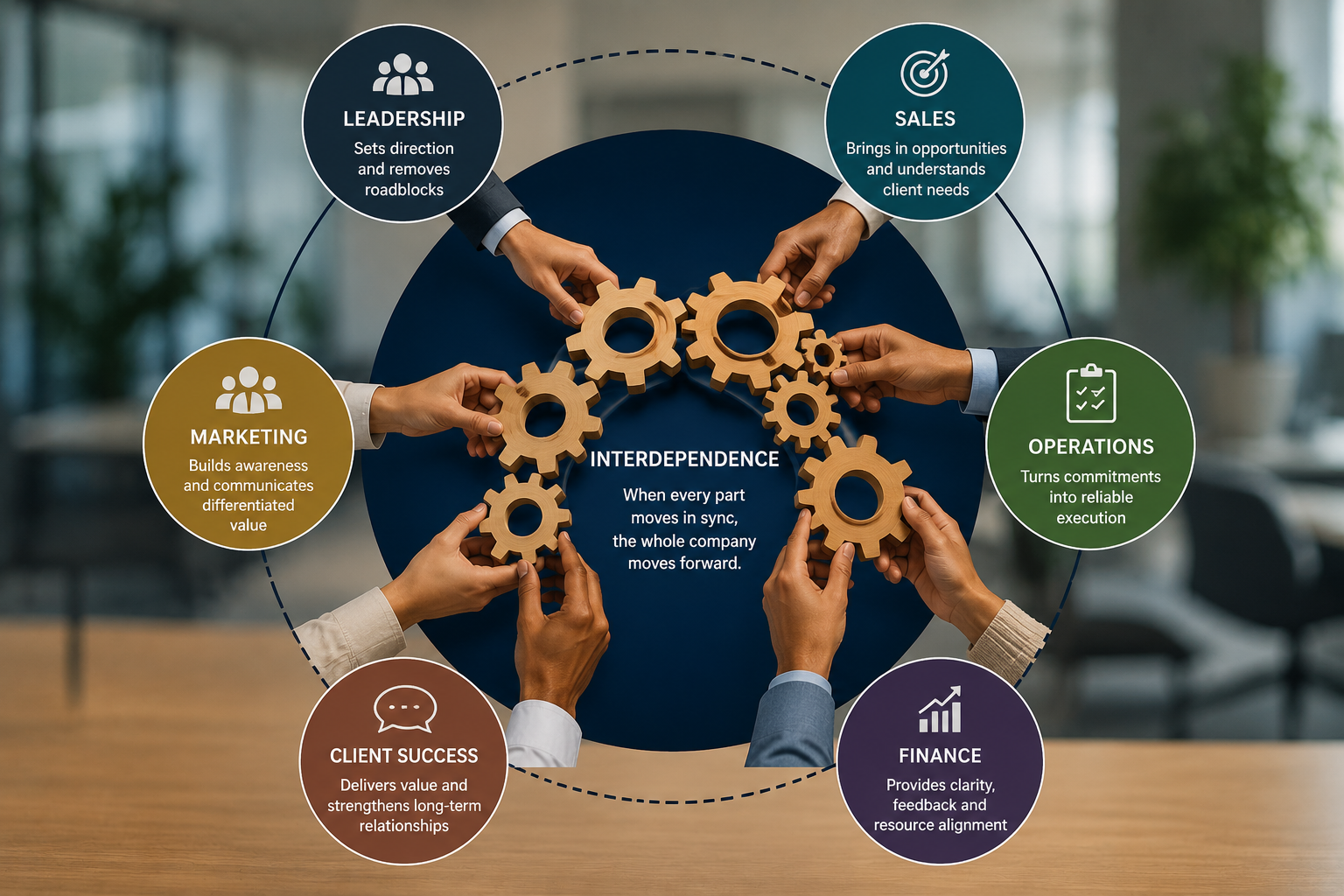
As Businesses Become More Established, Interdependence Increases
One of the least discussed realities in growing service businesses is this:
As companies become more established, performance becomes increasingly dependent on how well the organization operates together — not independently.
That distinction matters.
In smaller environments, strong individual performance can often compensate for operational inconsistency.
A great owner. A highly responsive team member. A strong project manager. An experienced client lead.
People step in. Problems get solved. Momentum continues.
But as the organization scales:
- communication paths multiply
- client demands diversify
- project complexity increases
- operational dependencies expand
- coordination requirements rise
- leadership visibility naturally decreases
The business should become more interdependent.
And that changes what operational strength actually looks like.
At that stage, isolated excellence matters less than coordinated execution.
The issue is no longer simply whether individuals are capable.
It becomes:
- how consistently teams move together
- how clearly priorities flow through the organization
- how operational rhythm is maintained under pressure
- how effectively communication supports execution
- how smoothly responsibilities connect across functions
This is where many owners begin feeling a subtle but growing operational strain.
Not because effort decreased.
But because the company now requires a stronger level of orchestration than it once did.
Different parts of the business can no longer operate independently without creating friction somewhere else in the organization.
The Company Begins Requiring More Coordination Than Visibility
One of the more challenging transitions for growing business owners is realizing that operational visibility naturally changes as companies scale.
In earlier stages, owners could often maintain direct awareness of:
- most client situations
- project movement
- team interactions
- operational priorities
- communication flow
- execution quality
The organization remains relatively visible.
But as complexity grows, leadership can no longer rely solely on direct oversight to maintain consistency.
The business increasingly depends on people operating from shared priorities, clearer communication rhythms, stronger execution consistency, and a greater awareness of how one part of the organization affects another.
That’s a very different operational environment.
And many businesses continue trying to operate more established organizations using earlier-stage operational habits.
This is often where friction quietly begins accumulating.
Not dramatic dysfunction.
Just operational drag.
Client work begins spilling across departments. Teams work hard, but not always from the same operational priorities. Leadership meetings revisit the same issues repeatedly. And owners find themselves pulled back into reconnecting moving parts that should already be operating together more effectively.
Individually, none of these issues may seem major.
Collectively, however, they change the ownership experience.
The company becomes harder to stabilize consistently.
And many owners respond by increasing involvement.
Which temporarily restores control… while also increasing operational dependence on the owner.
That’s an exhausting cycle for many business owners.
Because eventually, more involvement stops creating more leverage.
The Goal Is Not More Control
This is where many conversations around growth become misleading.
A lot of business advice assumes the solution is:
- more systems
- more accountability
- more delegation
- tighter oversight
- more management structure
But established service businesses rarely improve through rigidity alone.
The strongest organizations usually develop something different.
They develop operational rhythm.
That rhythm affects whether the organization can maintain consistency under pressure.
Whether teams continue moving from the same priorities. Whether client delivery remains steady as demands increase. Whether leadership can stay focused on direction instead of constantly reconnecting operational pieces in real time.
In healthy organizations, different parts of the business begin moving together more consistently.
Not perfectly. Not mechanically.
But intentionally.
People begin understanding how their work affects other areas of the business.
Teams communicate earlier. Operational timing improves. Pressure gets identified sooner. And execution becomes more connected instead of constantly reactive.
That operational awareness reduces friction.
And reducing friction matters more than many owners realize.
Because operational friction quietly affects:
- profitability quality
- leadership energy
- strategic focus
- client experience
- team consistency
- organizational stability
Most importantly, it affects the ownership experience itself.
Strong Companies Often Feel Calmer Internally
One of the more interesting things I’ve observed over the years is this:
The strongest companies are not always the loudest, fastest-moving, or most intense.
Very often, they simply operate with greater steadiness.
Leadership communicates more consistently. Priorities remain clearer. Operations support one another more effectively. And the business develops a steadier internal cadence even as complexity increases.
That steadiness creates leverage.
Not because the business has eliminated complexity.
But because the organization absorbs complexity differently.
And that changes the ownership experience dramatically.
In many more established service firms, the real challenge is not lack of effort.
It’s that the operational environment has become increasingly reactive.
Priorities shift faster than teams can stabilize around them. Communication becomes increasingly reactive. And leadership energy gets pulled toward maintaining operational continuity instead of strengthening long-term direction.
Over time, that creates a business that feels increasingly heavier to lead.
Even if growth continues.
Even if revenue remains healthy.
Even if the company is technically “successful.”
That’s why operational coordination matters more than many owners initially realize.
Because sustainable growth is not just about generating more activity.
It’s about creating a business that can operate more consistently as complexity increases.
Operational Rhythm Quietly Shapes Profitability
Most owners understand profitability through obvious drivers:
- pricing
- revenue
- payroll
- utilization
- margins
- overhead
Those matter.
But operational rhythm affects profitability too.
Often quietly.
When organizational rhythm weakens, companies often begin compensating with more effort.
More follow-up. More clarification. More meetings. More leadership involvement.
Not because people are failing. But because the business is no longer operating together as consistently as it needs to.
Individually, those things may seem operational.
Collectively, they affect profitability quality.
Not just whether revenue exists.
But how efficiently the organization converts effort into:
- margin
- consistency
- client confidence
- operational leverage
- organizational stability
That’s an important distinction.
Because many service firms continue growing revenue while simultaneously increasing operational friction.
And eventually, the business begins demanding more energy to maintain the same level of performance.
That affects:
- profitability
- pressure
- leadership capacity
- future scalability
- company value
- ownership payoff
This is one reason why two companies with similar revenue can create entirely different ownership experiences.
One feels coordinated. The other feels constantly reactive.
One creates operational steadiness. The other creates operational strain.
Revenue alone doesn’t reveal that difference.
Operational rhythm often does.
Mature Businesses Require More Intentional Orchestration
As service businesses grow, leadership itself changes.
The challenge eventually becomes less about execution and more about orchestration.
That does not mean owners should become distant.
Nor does it mean the company should operate without leadership involvement.
But it does mean the organization increasingly depends on:
- intentional coordination
- stronger communication rhythm
- operational alignment
- aligned execution
- organizational visibility
- interdependent awareness
In other words:
The company must increasingly operate as a connected organization rather than a collection of individual efforts.
And that transition is not always easy.
Especially for businesses that grew successfully through responsiveness and adaptability.
But this is also where ownership can begin improving in more meaningful ways.
Because stronger orchestration creates:
- steadier execution
- clearer operational flow
- more consistent profitability
- reduced friction
- improved leadership leverage
- greater organizational resilience
And over time, it creates stronger future options.
Not just for growth.
But for:
- sustainability
- scalability
- leadership continuity
- operational resilience
- long-term company value
- eventual transition or exit opportunities
A Quick Example
A marketing agency owner I once spoke with had built a successful company over more than a decade.
Revenue was healthy. The client roster was strong. The team was capable.
Yet the business constantly felt tense beneath the surface.
Not because people were failing. And not because the company lacked talent.
The real issue was that the business was still operating with many of the same habits that helped create early growth.
Different departments were working hard, but not always from the same operational priorities.
Client pressure frequently redirected attention. Communication became increasingly reactive. And leadership meetings often circled the same operational issues because teams were solving problems from different directions instead of operating from a more connected rhythm.
On paper, the company looked successful.
But internally, too much energy was being spent reconnecting moving parts that should have already been operating together more intentionally.
Over time, that affected:
- team consistency
- profitability quality
- leadership energy
- operational steadiness
- and the owner’s overall resilience
The turning point was not some dramatic operational overhaul.
It was the realization that the company no longer needed more activity.
It needed stronger operational rhythm.
The leadership team began paying closer attention to where momentum was getting lost between departments, communication flow, client delivery, and shifting priorities.
Not just within individual functions — but between them.
Instead of solving every issue independently, they focused on improving how the organization operated interdependently.
And gradually, the business began feeling steadier.
Not perfect. Not slower.
Just more coordinated.
That changed the ownership experience significantly.
Final Thought
Many seasoned business owners assume the growing operational weight they feel is simply the inevitable cost of success.
Sometimes it is not.
Sometimes the business has simply evolved into a more established operational environment than its current rhythm was designed to support.
That is a very different problem.
And often, a much more solvable one.
Because improving the ownership experience is not always about:
- working harder
- adding more activity
- increasing oversight
- implementing another framework
Sometimes it begins by paying closer attention to where operational friction is being created between functions — not just within them.
Watch where momentum gets lost between teams, priorities, communication flow, and execution rhythm.
Because those patterns often reveal far more about the health of an organization than revenue alone.
Sometimes it begins by recognizing that strong companies do not simply grow.
They learn how to operate together more intentionally as complexity increases.
And in many service-based businesses, that operational rhythm quietly becomes one of the biggest drivers of profitability, leadership resilience, organizational stability, future value, and ultimately, the quality of ownership itself.
If you’re building a service-based business that has traction, strong client relationships, and meaningful revenue — but ownership itself is starting to feel heavier, more reactive, or more operationally demanding than it should — it may not be a growth problem.
It may be an orchestration problem.
That’s often where stronger operational rhythm, organizational coordination, and strategic visibility begin changing not just company performance — but the ownership experience itself.
That’s exactly why we're opening a number of Owner Payoff Review™ conversations for a limited time in July for seasoned service-based business owners.
This is a curated private strategic conversation designed to evaluate what your business is actually creating—in profitability, pressure, control, strategic flexibility, ownership payoff, and future options.
For owners who’ve built something meaningful…
…but suspect the next stage should produce something better than simply more activity.
If this conversation feels relevant to where your business is today, you can learn more and schedule an Owner Payoff Review™ below:
Receive Strategic Insights for Profitable Growth & Long-Term Value
If you’re focused on building a business that performs well today while becoming more valuable and sustainable over time, you’re in the right place.
I share thoughtful strategic insights for established service-based business owners on profitability, clarity, and intentional growth — along with occasional updates from the Scaling with Intent platform.
No noise. No generic business tips. Just strategic insight for owners scaling with intent.