Your Business Changed. Did Your Company?
Why This Matters...
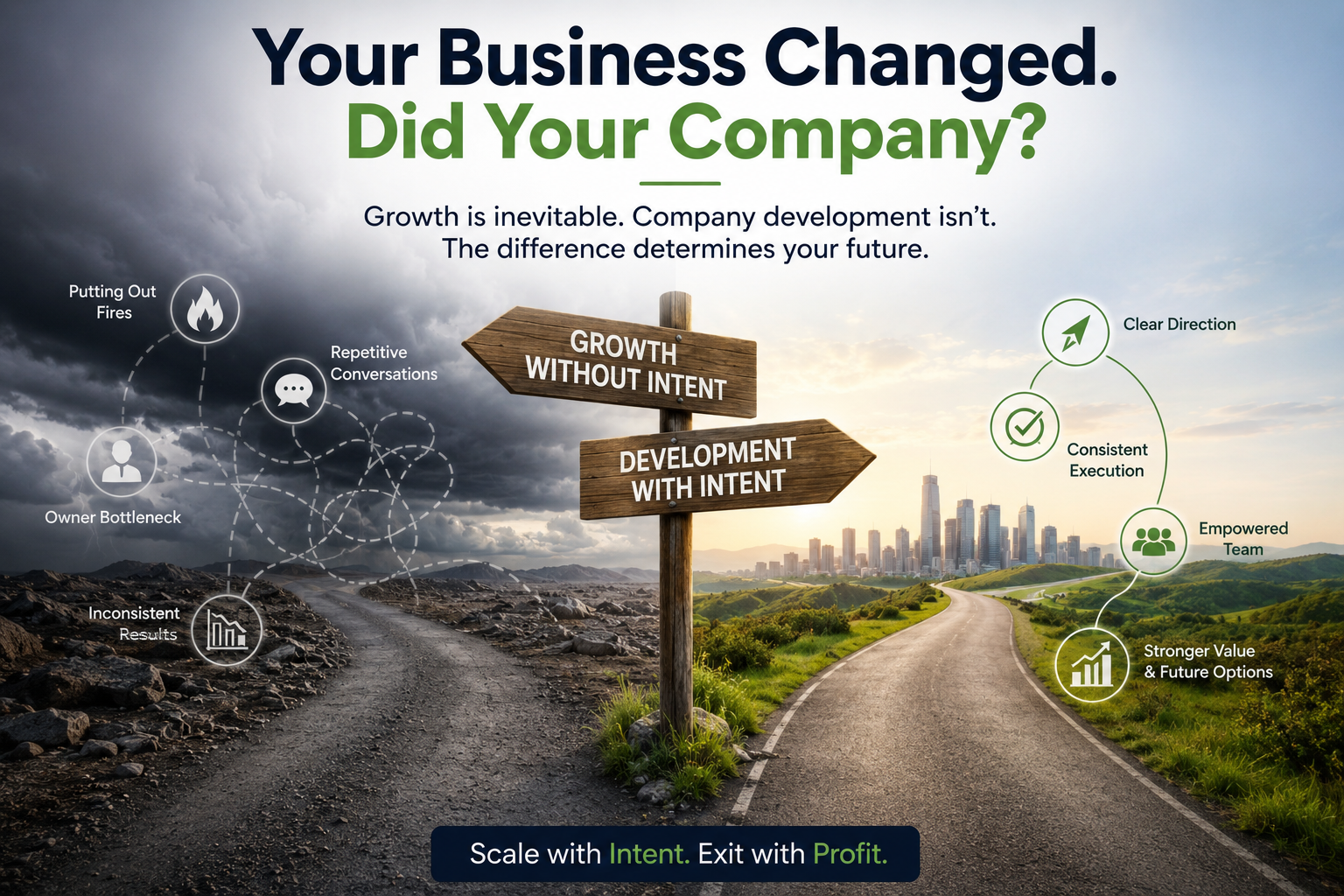
Growth changes every business. But companies don't automatically become stronger as they grow. In this article, we explore how hidden complexity quietly affects profitability, operational stability, company value, and the future options available to business owners—and why intentionally developing the company itself may be one of the most overlooked drivers of long-term success.
When Growth Starts Feeling Different
I was talking with a business owner recently and asked what had become more complicated in the business.
He paused for a moment.
“Honestly…I'm not even sure what's changed. It just feels like everything takes more effort than it used to.”
It wasn't the answer I expected, but it was one I've heard in different forms for years.
Sometimes it's, “Everything feels more fragmented.”
Sometimes it's, “I feel like I have to have eyes on everything.”
Sometimes it's simply, “We're always putting out fires.”
Then, almost without noticing, everything seems to require just a little more effort.
The Complexity You Can See—And the Complexity You Can't
Not dramatically more. Just enough that the owner starts to feel it.
More follow-up. More checking. More conversations. More exceptions. More things that seem to find their way back to the same few people—or back to the owner.
Many owners assume this is simply the price of growth.
That's true—to a point.
Growing businesses tend to face more complexity. But that doesn't mean every layer of complexity is necessary, productive, or even directly caused by growth.
Some complexity reflects a business doing more.
Other complexity is created quietly by the way the company is operating.
A service business with three employees can operate very differently from one with nine or ten. You don't have to become a big company to cross the point where the habits that worked when everyone knew everything no longer work quite as well.
The owner may still know every client. The team may still be small enough to fit around a conference table. There may be no layers of management and no desire to create them.
But the business has changed.
When Workarounds Become the Way You Work
The question is whether the company has changed with it.
I'm talking about how the business actually functions day to day: how work moves from one person to another, how responsibilities are understood, how expectations are communicated, how clients experience the firm, how financial information is used, and how problems are handled when something doesn't go according to plan.
Those things rarely change simply because revenue increased.
They have to be developed.
That's where invisible complexity begins to matter.
Visible complexity is easy to recognize. There are more clients, more employees, more projects, perhaps more services or software.
Invisible complexity is different.
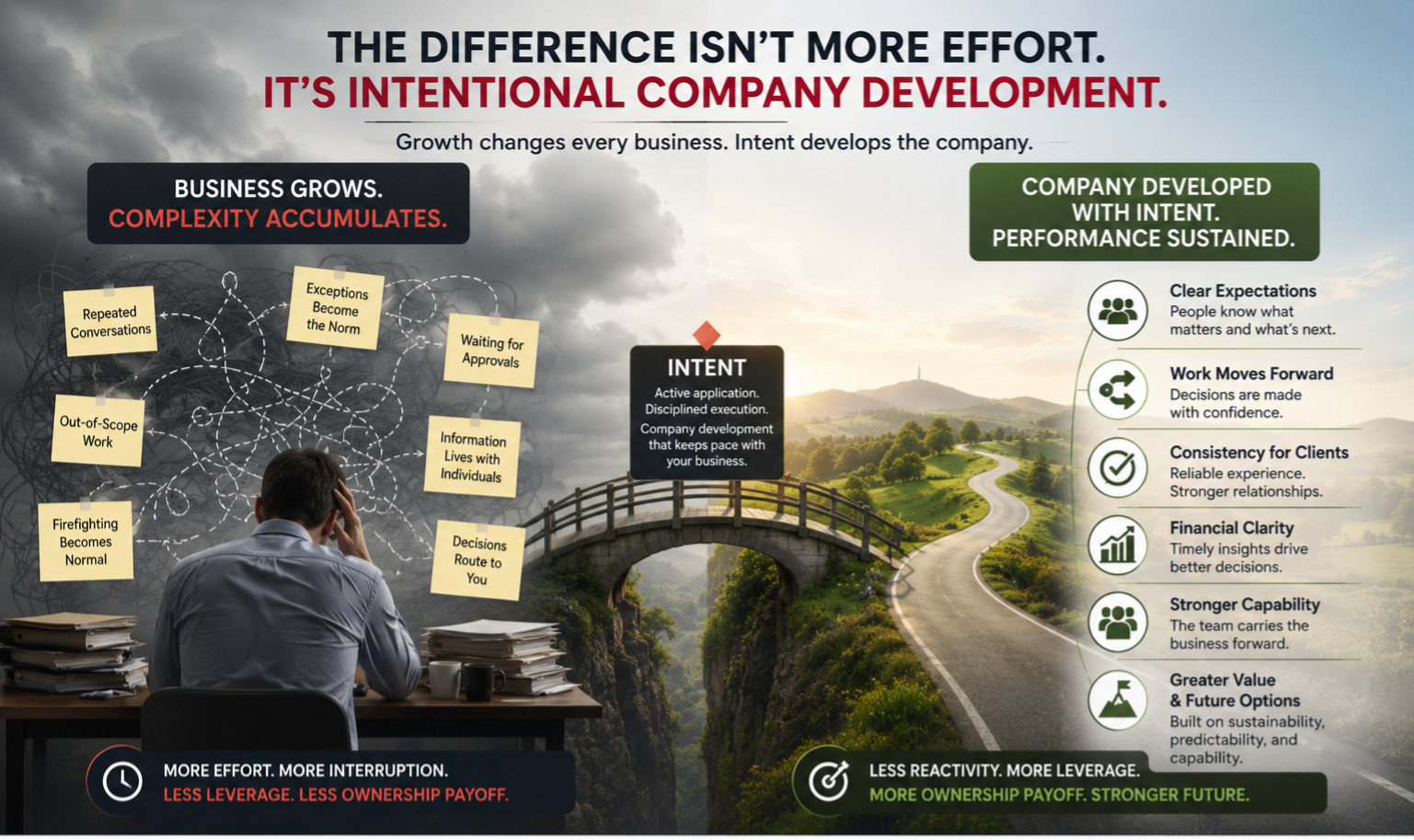
It's the third conversation about something everyone thought was already clear. It's the project manager checking with the owner “just to be safe.” It's the client request that isn't technically in scope but gets handled anyway because it seems easier than having the conversation. It's two employees performing the same task differently because each learned it at a different time. It's another meeting added because the last meeting didn't quite resolve the issue. It's someone going on vacation and suddenly discovering how much client knowledge lives with one person.
None of those things looks particularly alarming on its own.
That's precisely why they're easy to miss.
Invisible complexity doesn't just add work. It changes how work moves through the company.
An exception creates another conversation. That conversation may create another approval. The approval creates a delay. The delay prompts a client question. The client question brings another person into the discussion. Eventually, something that should have moved cleanly through the company has required four people, six messages and the owner's attention.
The next time it happens, does everyone remember the workaround?
Growth vs. Intentional Company Development
And that's when a temporary response can quietly become the way the company operates.
A few minutes here and there don't show up on an income statement as “unnecessary complexity.” Neither does the time spent re-explaining expectations, correcting work that moved through an inconsistent process, chasing information, managing scope that was never clearly defined, or pulling another person into a project because the handoff wasn't clean.
But the cost is there.
It appears in capacity. It appears in margins. It appears in client consistency. And it appears in the amount of owner attention required to keep everything moving.
“We're always putting out fires.”
“I'm tired of having to tell this employee the same thing repeatedly.”
“I have to check everything before it's marked complete.”
Owners often say these things as though they're describing the unavoidable realities of running a service business.
Sometimes there really is an employee performance issue. Sometimes a client really is unusually demanding. Sometimes a project really does require owner involvement...BUT not always...
The Business You Built Isn't the Business You're Running
When the same frustration keeps showing up, it's worth looking beyond the immediate person or project.
Repeated problems often tell you something about the company.
At first glance, the obvious conclusion is that the employee isn't listening.
Maybe.
But what if three different employees have needed the same clarification over the past two years? What if the owner believes the expectation is obvious, while each employee has interpreted it differently? What if the instruction changes slightly depending on the client, the deadline, or who happens to be asking?
At that point, continuing to repeat the instruction may solve today's problem without addressing what keeps creating it.
The issue isn't simply whether someone heard the owner.
It's whether the expectation has become clear and consistent enough to operate without repeated interpretation.
Capability Creates Resilience
A marketing agency agrees to a defined package, but a good client asks for “one quick thing.” Then another. An IT consulting firm agrees to specific support parameters, but the team keeps solving issues that fall outside them because saying yes feels easier in the moment.
Each exception may make perfect sense individually.
But enough exceptions can change the economics of the work.
What looked like a client-service decision becomes a profitability issue.
What looked like flexibility becomes an expectation.
What looked like an exception becomes the norm.
Complexity isn't necessarily a problem to eliminate.
Unnecessary complexity is something to recognize, review and adjust accordingly.
The goal is to notice where complexity is serving the business—and where the business is serving the complexity.
I used to assume that by the time an owner had been in business for ten or fifteen years, growth itself became more deliberate.
I've found that isn't necessarily true.
Even seasoned owners can grow reactively.
A referral comes in. A good client wants more. There's an opportunity to add a service. Capacity gets tight, so another person is hired. A new employee has experience, so everyone assumes they'll know how to handle the work. A project is larger than usual, so the team figures it out as they go.
None of those decisions is inherently wrong. In fact, they may be very good decisions individually.
But a series of good individual decisions doesn't automatically add up to intentional growth.
Wanting more clients and more revenue isn't the same as deciding what kind of company needs to exist to support them.
That's where intent matters.
Most owners have good intentions. They intend to hire well. They intend to communicate clearly. They intend to improve margins. They intend to develop people. They intend to build a company that gives them more options later.
Intent requires more than that.
Intent is the active application of the plan. It's deliberately developing the company and carrying out the changes needed to support where the business is going.
That's the difference between simply experiencing growth and scaling with intent.
A Better Lens Going Forward
More clients change the volume and variety of work. More employees change communication. New services change delivery. Larger projects change risk. Different clients change expectations.
The company has to respond somehow.
If that response isn't intentional, it still happens. It simply happens through workarounds, extra conversations, owner intervention, informal rules and whatever gets the job done today.
That's how invisible complexity can accumulate even inside a successful company.
At some point, the business you built isn't necessarily the business you're running anymore.
The three-person company where everyone heard every client conversation may now have nine employees. The owner can no longer assume everyone knows what they know. One person's absence matters differently. A loosely defined responsibility can affect several projects instead of one. A pricing decision can have a much larger effect on capacity and margins.
The company isn't “big.”
It's simply different.
And operating it as though it's still the earlier version creates friction that growth itself doesn't have to create.
This is also why two service businesses with similar revenue, similar team sizes and similar client profiles can produce very different results.
The other company isn't problem-free. But work moves more consistently. People understand where their responsibilities begin and end. Someone can step into a colleague's project without reconstructing the entire history. Client expectations are clearer. Financial information supports conversations before a problem becomes urgent.
The difference isn't perfection.
It's capability.
It looks like a client receiving a consistent experience even when their usual contact is away. It looks like an employee knowing when they can make the call and when something genuinely needs to be escalated. It looks like defined roles that reduce overlap without creating silos. It looks like a team recognizing out-of-scope work before a month of unbilled effort has disappeared into a client relationship. It looks like financial information that tells the owner more than how much money is in the bank.
And it looks like fewer situations where the owner has to step in simply because no one is sure what happens next.
Every business faces disruption. A key employee leaves. Someone takes an extended vacation. A client changes direction. Technology fails. A project goes sideways. An unexpected opportunity appears at exactly the wrong time.
Some companies absorb those events reasonably well.
Others amplify them.
The difference often isn't how hard everyone works. It's whether the company has enough consistency, shared knowledge, financial visibility and clarity to respond without turning every disruption into a crisis.
Calm.
I've heard owners joke that if things ever got quiet, they'd assume something was wrong.
That's understandable. If you've spent years responding to urgency, intensity can begin to feel like proof that the company is busy, needed and moving.
Steadiness can feel almost suspicious.
But calm isn't the absence of work.
It's often an unexpected sign of company strength.
The difference is that normal business pressure doesn't automatically become chaos.
A mistake gets corrected without six people being pulled into it. A client question gets answered without the owner being copied on every email. A team member takes vacation without everyone holding their breath. A project changes direction without destroying the economics of the engagement.
That kind of steadiness isn't complacency.
It's evidence that the company has developed the ability to absorb more of what business naturally throws at it.
And that has a direct financial consequence.
Why Buyers Value More Than Revenue
When work moves more consistently, rework tends to decrease. When scope is clearer, margins are better protected. When people understand their responsibilities, time isn't lost waiting for unnecessary approvals. When the owner has useful financial information, problems can be interpreted earlier instead of explained after the fact.
None of those improvements is flashy.
Together, they can make profitability less fragile. They can make cash flow more predictable. They can make growth less dependent on adding more effort every time the business adds more revenue.
They also influence something many owners don't seriously consider until much later: what the company may eventually be worth to someone else.
Owners understandably focus on revenue, profit and perhaps an industry multiple when they begin thinking about value.
A buyer looks at those things too.
But a buyer is also asking a more fundamental question:
“How much confidence can I have that this company can sustain its performance—and its profits—after the current owner is no longer sitting in that chair?”
That question changes the conversation.
A buyer may admire what you've built. But they're valuing what they believe will remain after you leave.
Can clients be served consistently? Can the team continue performing? Are responsibilities understood? Are financial results credible and reasonably predictable? Does valuable knowledge live throughout the company or primarily in the owner's head? Can the company withstand the departure of one employee without significant disruption? Does the business produce its results through repeatable capability—or through heroic effort?
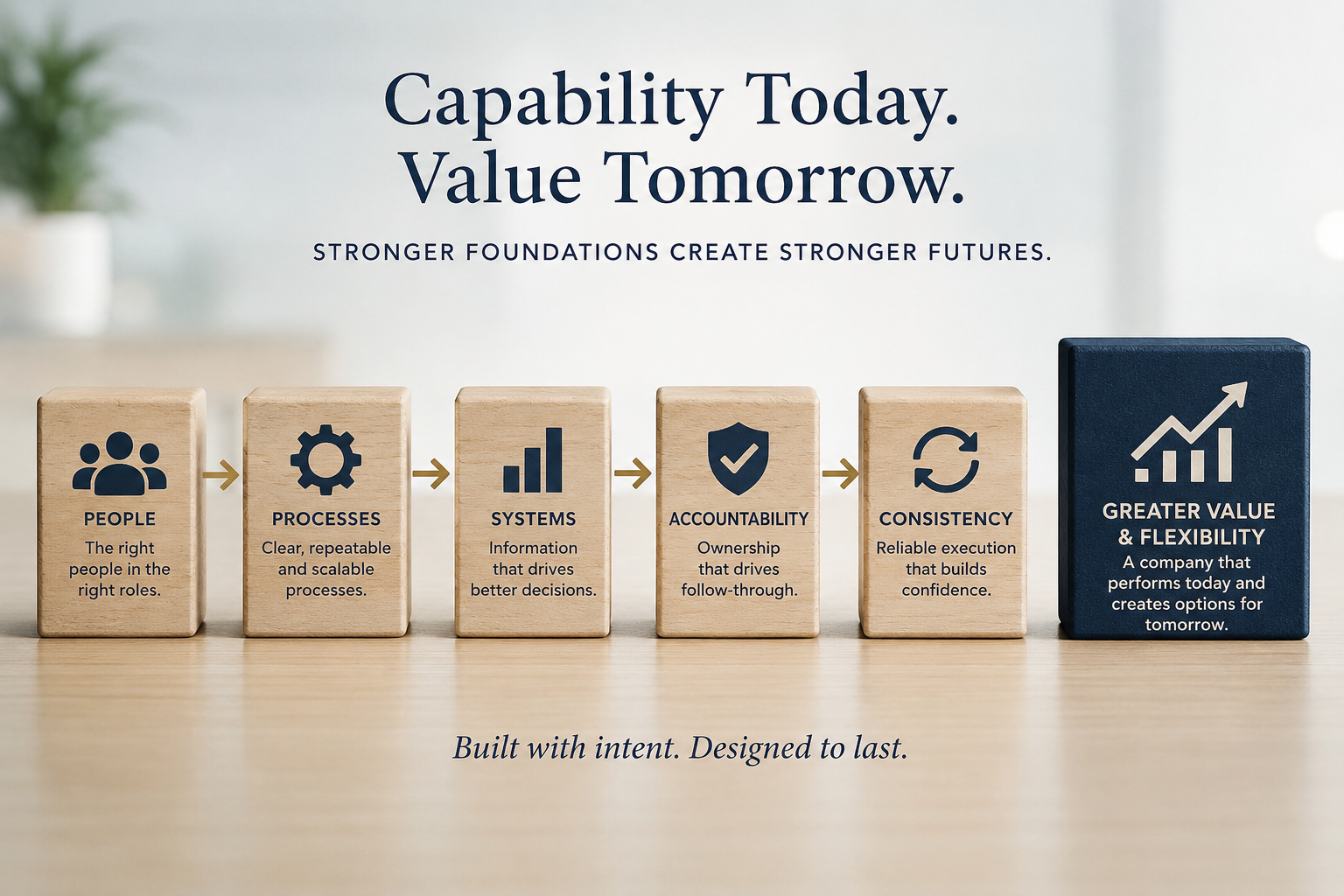
Predictability, consistency and capability matter because they give a buyer greater confidence that what they're buying is sustainable.
A Better Company To Own Today
Ironically, the qualities that make a company more valuable in the future also make it more profitable, resilient, and enjoyable to own today.
A son or daughter taking over the company doesn't want to inherit a business that requires the founder's constant interpretation. A management team considering an internal transition needs to know the company can perform without informal rules that only the owner understands.
And an owner who has no intention of leaving anytime soon still benefits from the same qualities.
A company that can sustain performance without extraordinary owner effort isn't only more attractive to a future buyer or successor.
It's generally a better company to own now.
A stronger company can create better profitability today and more flexibility tomorrow. It can give you greater confidence to pursue an opportunity—or turn one down. It can give you the option to take more time away without wondering whether everything will fall apart. It can make a future transition more realistic.
And it can increase the likelihood that the value you believe you've built is value someone else will actually recognize.
What Your Company Is Becoming
I'd become curious about what the extra effort is revealing.
What has quietly become normal? Which conversations keep repeating? Where have exceptions become routine? Where is work moving through more people than it needs to? Where does one person's absence expose a weakness no one noticed before? Where is the owner still compensating for something the company hasn't yet developed?
Those aren't questions about making the business perfect.
They're questions about what kind of company the business is becoming.
Growing businesses tend to face more complexity.
The objective isn't to eliminate it.
It's to distinguish the complexity that comes with serving more clients, employing more people and pursuing bigger opportunities from the complexity that has accumulated simply because no one stopped to recognize it, review it and adjust accordingly.
That distinction matters.
Because unnecessary complexity consumes capacity.
Capability creates it.
And over time, that difference shows up in profitability, resilience, company value and the options available to the owner.
Scale With Intent
Growth changes every business.
The question isn't whether your business has grown. It's whether your company has grown with it.
And that doesn't happen simply because you intended to build a great company.
Intent requires something more. It means actively developing the company you're running today for the business you're trying to create tomorrow.
That means noticing what has quietly become normal. Recognizing unnecessary complexity, reviewing what it's costing the business and adjusting accordingly. Building capability where effort has been compensating for its absence.
As we’ve previously mentioned, yet it deserves mentioning again, ultimately the value of the company isn't determined only by what it produces today.
It's also reflected in how reliably and sustainably it can continue producing those results tomorrow—for you, for a successor, or eventually for a buyer.
Growth changes every business.
Long-term value comes from intentionally developing the company as the business grows.
That's what it means to Scale with Intent.
And that's what creates a business that is increasingly worth owning.
Receive Strategic Insights for Profitable Growth & Long-Term Value
If you’re focused on building a business that performs well today while becoming more valuable and sustainable over time, you’re in the right place.
I share thoughtful strategic insights for established service-based business owners on profitability, clarity, and intentional growth — along with occasional updates from the Scaling with Intent platform.
No noise. No generic business tips. Just strategic insight for owners scaling with intent.